
February 2, 2026
Formation Over Fracture
Some of you may be familiar with the political scientist and Baptist pastor Ryan Burge. Through his Substack, Burge offers thoughtful and accessible analysis of emerging trends in American religion. A few years ago, I had the opportunity to interview him about his book The Nones, and I’ve continued to appreciate the clarity and care he brings to difficult conversations about faith in our time.
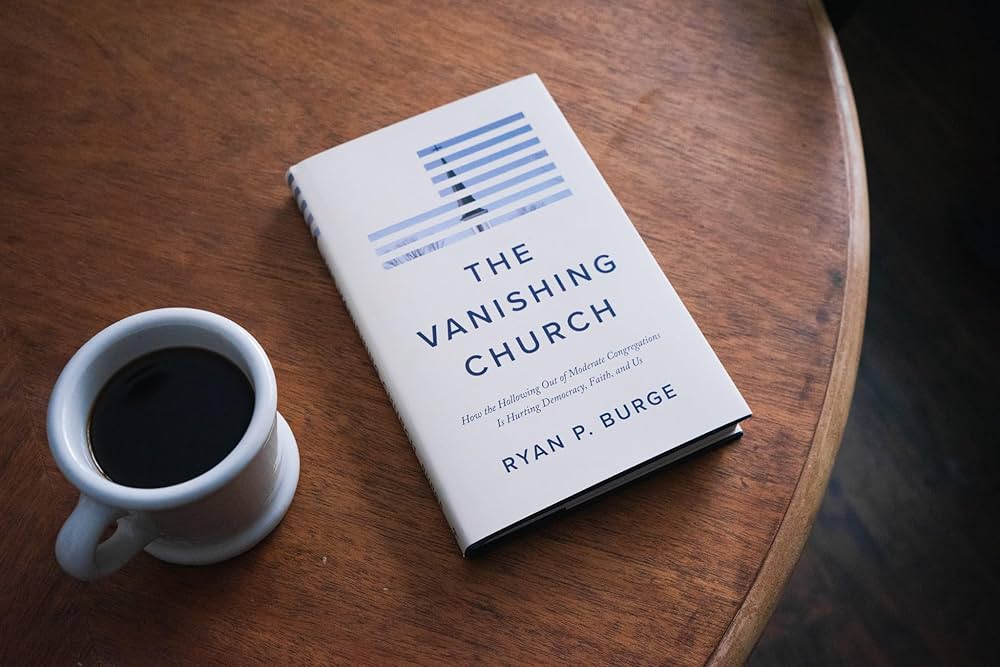
I recently finished reading Burge’s newest book, The Vanishing Church: How the Hollowing Out of Moderate Congregations Is Hurting Democracy, Faith, and Us. It is a fascinating—and at times deeply sobering—look at how American churches have become increasingly polarized along political lines. This is especially true in evangelical churches (and increasingly within Catholic contexts as well), where political diversity has largely disappeared. Decades ago, evangelical congregations were often places where Republicans and Democrats worshiped side by side. That is far less common today. As Burge writes, “A movement that used to be fairly diverse politically and theologically has become what is often caricatured in the mainstream media—a whole lot of theologically conservative Republicans” (29).
One of the few remaining spaces in American Christianity where political diversity still exists is within what are often called “mainline” churches—long-established denominations such as Presbyterians, Methodists, Episcopalians, and others. There is a common assumption that as evangelical churches have drifted to the far right, mainline churches have drifted to the far left. Yet Burge notes that the data tells a more nuanced story. While denominational leadership may publicly align with certain causes, local congregations themselves remain an honest mix of left, right, and center—churches where people with different convictions still gather around Word and Table.
What makes this especially poignant is that these politically diverse congregations have experienced the sharpest decline in American Christianity. Burge makes a compelling case that the erosion of these shared spaces has contributed not only to political polarization, but also to the loss of places where patience, humility, and love for neighbor can actually be practiced over time.
As you know, Ardmore Baptist Church does not fit neatly into any single category. We carry genuine evangelical DNA from our Southern Baptist roots, and at the same time we have long resisted defining our faith primarily by ideological alignment. We affirm women in leadership, we refrain from culture-war posturing, and our commitment to traditional, liturgical worship reflects a deep desire to be shaped by practices that form us over time. What ultimately holds us together is not a shared politics, but a shared commitment to being formed—slowly and imperfectly—into the likeness of Christ.
Living into that calling is not always easy. I recently shared about conversations with individuals who chose to leave Ardmore because our church did not clearly champion their particular political convictions. In one case, someone was deeply disappointed that we did not include a formal moment of remembrance following the death of conservative activist Charlie Kirk. In another, someone longed for our church to be more publicly vocal in its advocacy around LGBTQ issues. In both conversations, I expressed genuine care and a sincere hope that they might stay. At the same time, I was honest that Ardmore’s primary task is not to reinforce pre-existing views, but to help form disciples of Jesus.
[…] The erosion of these shared spaces has contributed not only to political polarization, but also to the loss of places where patience, humility, and love for neighbor can actually be practiced over time.
That does not mean we avoid difficult conversations. It does mean that our worship, our preaching, and our common life are shaped first by the way of Christ—by practices of prayer, repentance, humility, Scripture, and love—rather than by the urgency of the news cycle or the pressure to signal allegiance.
Near the end of his book, Burge offers wisdom that resonates deeply with this vision.
He reminds churches to learn how to spot fringe beliefs—voices that thrive on outrage and treat disagreement as a moral failure. While passion has its place, formation requires something deeper: patience, listening, and restraint. The church can be one of the few spaces where our loves are reordered and our reflexes softened by grace.
He also cautions against treating the church like a consumer product. Formation, by its very nature, requires staying—staying when things feel uncomfortable, when we are challenged, and when we are reminded that none of us sees clearly all the time. Growth rarely happens in spaces that simply mirror us back to ourselves.
Finally, Burge warns against dehumanizing the other. Churches, at their best, are places where people with real differences come to know one another as neighbors and friends. Over time, shared worship, shared service, and shared stories make it harder to reduce one another to labels. In that slow work of knowing and being known, prejudice begins to lose its grip.
I truly believe that Ardmore’s calling in this moment is not to be a church of ideological agreement, but a community of intentional formation—a people committed to apprenticing themselves to Jesus together. In a culture shaped by outrage and hurry, choosing the slow work of Christlikeness is a quiet act of resistance. My hope is that Ardmore will continue to be a place where our loves are shaped by the Spirit, where disagreement is held within grace, and where, over time, we find ourselves becoming a little more like Christ—for the sake of the world God so deeply loves.
Grace and peace,
Rev. Tyler Tankersley